搜索







 Time:Mar 31, 2025
Recently, the team of Professor Xiaodong Zhuang at the Center for Synthetic Science Innovation, Zhangjiang Institute for Advanced Study, Shanghai Jiao Tong University, successfully synthesized a high-crystallinity three-dimensional graphdiyne framework with ThSi₂ topology by precisely designing isomeric monomers.This groundbreaking research adds a new member with diacetylene linkages to the family of 3D covalent organic frameworks (COFs), and reduces the bandgap of graphdiyne-type materials to 1.15 eV—a new record among COFs without π–π stacking interactions—providing a new design direction for the development of optoelectronic and energy devices.
Two-dimensional graphdiyne (GDY), owing to its unique electronic properties and structural diversity, has shown great potential in energy storage, optoelectronic detection, and biosensing since its first synthesis in 2010.However, traditional 2D GDY synthesis is mostly limited to planar stacking structures, and fabricating crystalline 3D graphdiyne frameworks remains a major challenge.The main difficulty lies in the lack of suitable monomer design and the driving force for ordered 3D self-assembly.Moreover, bandgap tuning of graphdiyne has long been a focus of research. Balancing narrow bandgap with high crystallinity is difficult, limiting its applications in optoelectronic devices.
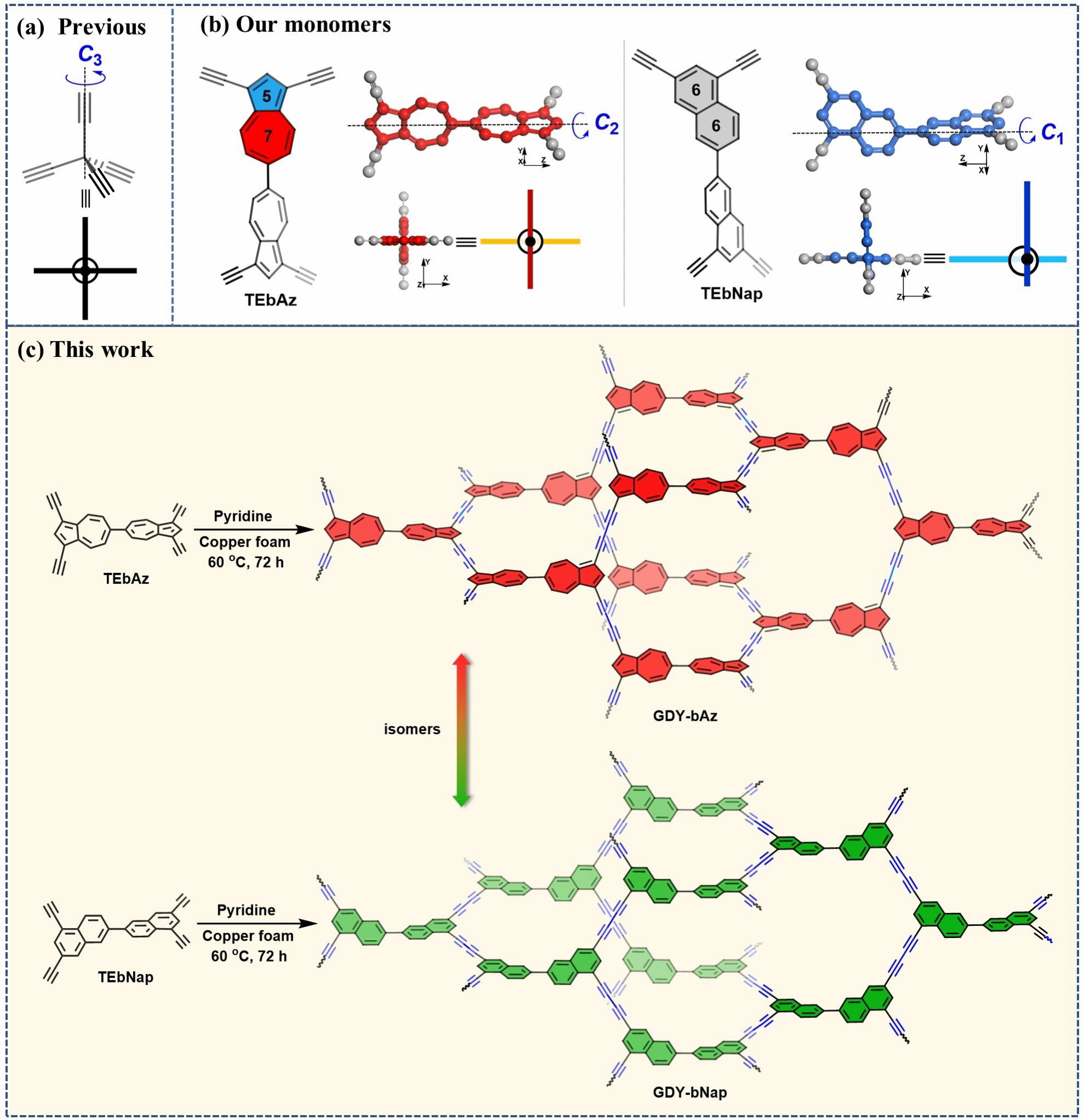
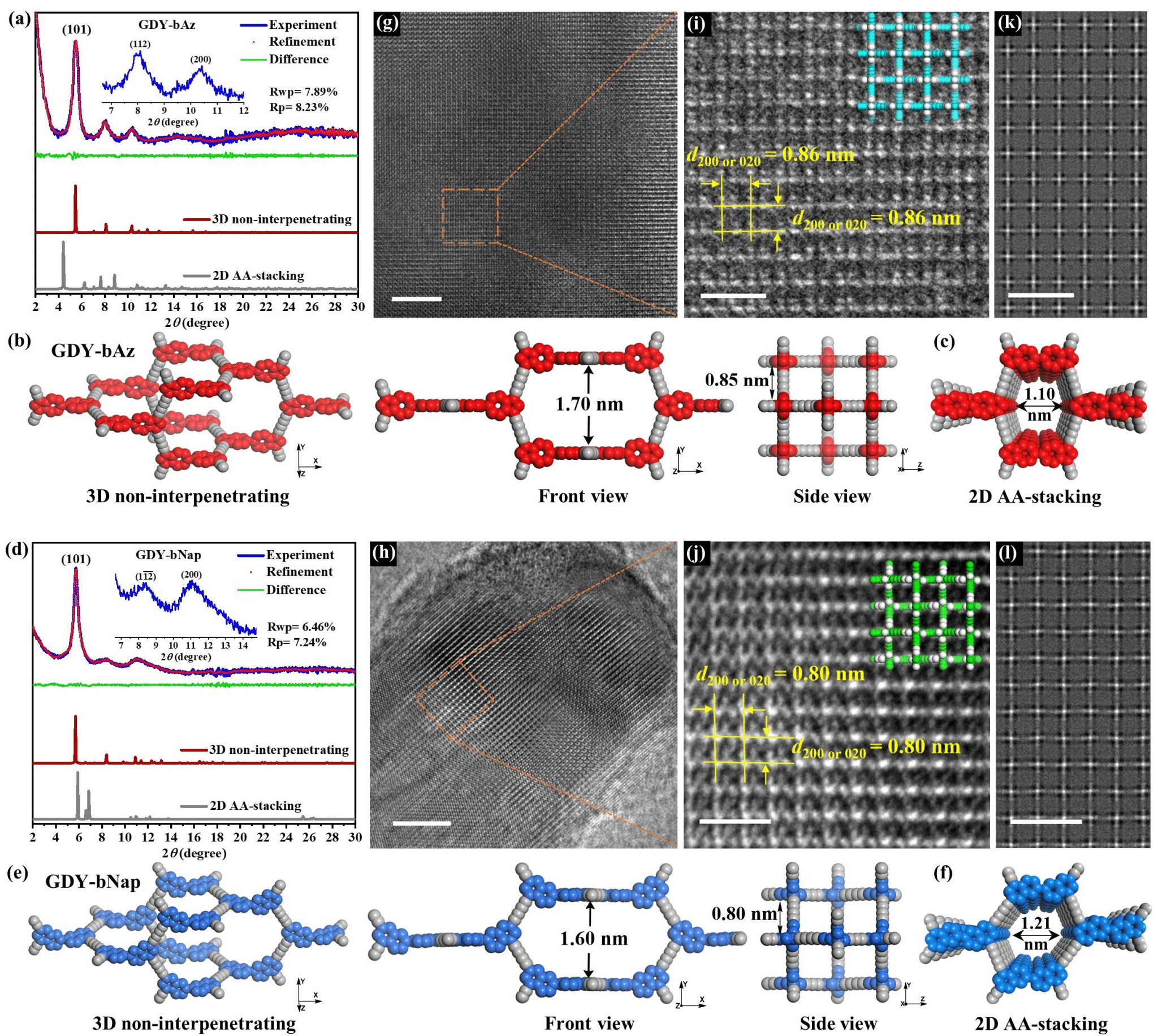
The research team designed two isomeric monomers with C1 and C2 axial symmetry—tetraethynyl monomers based on 2,2'-binaphthyl (bNap) and 6,6'-biazulene (bAz), named TEbNap and TEbAz, respectively.Unlike traditional monomers with C3 symmetry, these non-planar monomers underwent Glaser-Hay coupling reactions on copper foam substrates to form 3D graphdiyne frameworks, named GDY-bNap and GDY-bAz (Figure 1).Powder X-ray diffraction (PXRD) and high-resolution transmission electron microscopy (HR-TEM) confirmed that both frameworks exhibit non-interpenetrated ThSi₂ topologies with excellent crystallinity, and pore sizes of 1.6 nm and 1.7 nm respectively (Figure 2).Diffuse reflectance UV-Vis spectroscopy and density functional theory (DFT) calculations revealed that GDY-bAz, due to the large dipole moment of the azulene unit, exhibits an ultra-narrow bandgap of just 1.15 eV, significantly lower than the 2.33 eV of GDY-bNap.
With dual continuous channels and tunable electronic structures, the 3D graphdiyne frameworks are ideal hosts for loading single-atom metals.
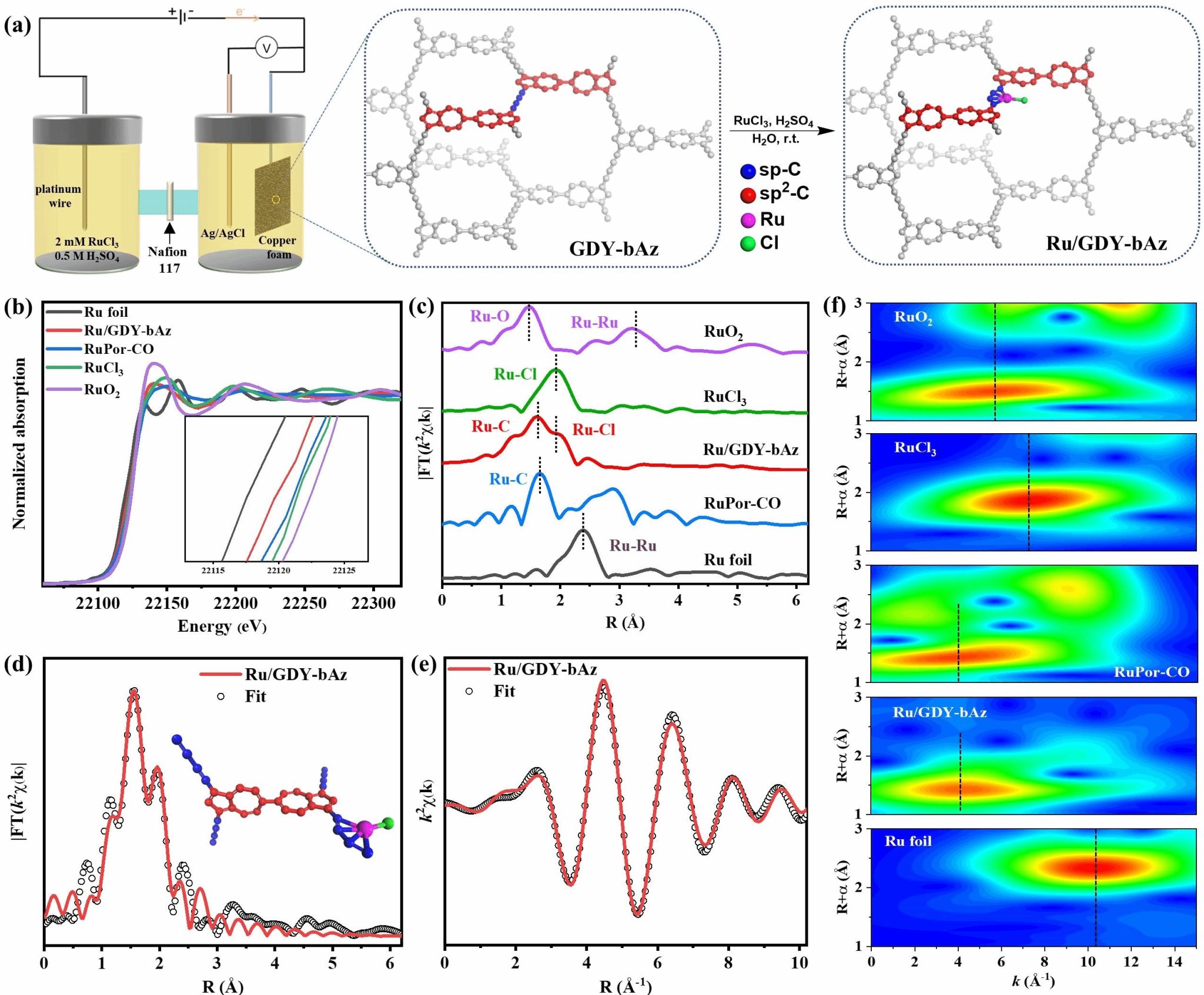
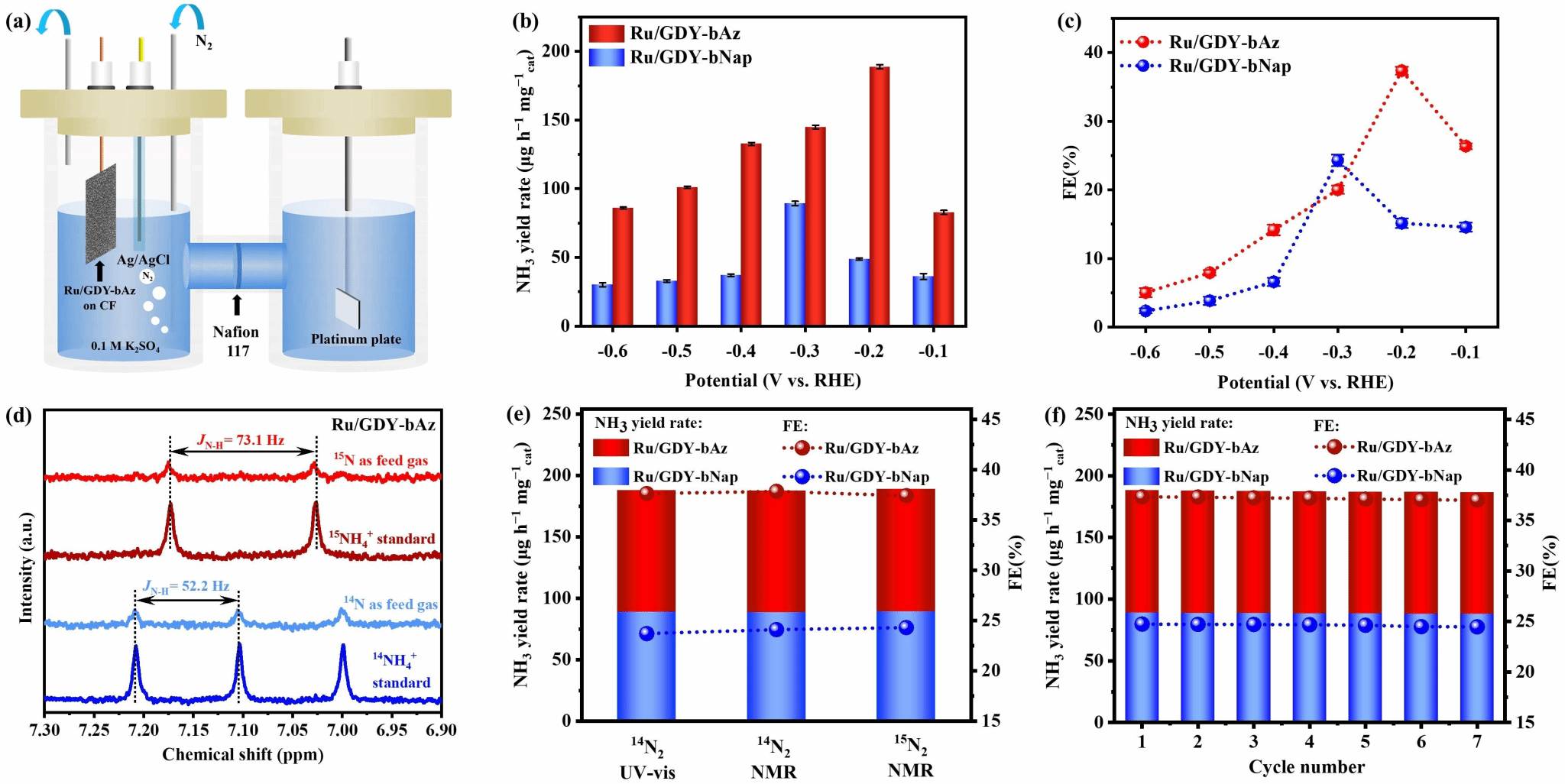
Using electrochemical deposition, the team embedded single ruthenium (Ru) atoms into GDY-bAz and GDY-bNap, preparing Ru/GDY-bAz and Ru/GDY-bNap catalysts (Figure 3).X-ray absorption fine structure spectroscopy (XAFS) and aberration-corrected high-angle annular dark-field scanning transmission electron microscopy (HAADF-STEM) showed that Ru atoms were uniformly dispersed in single-atom form and formed stable Ru–C coordination with the diyne linkages.In electrocatalytic nitrogen reduction reaction (ENRR) tests, Ru/GDY-bAz demonstrated excellent performance, achieving an ammonia yield of 188.7 ± 1.6 μg h⁻¹ mgcat⁻¹ at a low potential of -0.2 V vs RHE, with a Faradaic efficiency (FE) of 37.4 ± 0.6%, significantly outperforming Ru/GDY-bNap (89.3 ± 1.5 μg h⁻¹ mgcat⁻¹, FE 24.3 ± 0.8%, Figure 4).Online differential electrochemical mass spectrometry (DEMS) and in situ Raman spectroscopy revealed that Ru/GDY-bAz catalyzes nitrogen reduction through an alternating pathway, and the formation of key intermediate N₂H₂ greatly enhances its catalytic efficiency (Figure 5).DFT calculations further showed that the narrow bandgap and stronger charge transfer ability of GDY-bAz lowered the reaction energy barrier, maintaining high selectivity even against competing hydrogen evolution reactions (Figure 6).This work not only achieved rational synthesis of 3D graphdiyne frameworks, but also effectively tuned the bandgap by introducing azulene units, offering a new approach for developing narrow-bandgap, high-crystallinity covalent organic frameworks.Additionally, the single-Ru catalysts based on these frameworks demonstrated outstanding performance in electrocatalytic nitrogen reduction, showing great potential for sustainable ammonia synthesis.
Currently, this study is published in Advanced Materials (Adv. Mater.) under the title:"Rational Synthesis of Isomeric Graphdiyne Frameworks towards Single-Ruthenium Catalysts and High-Performance Nitrogen Reduction".Dr. Boxu Feng from Shanghai Jiao Tong University, doctoral researcher Dong Zhang from ShanghaiTech University, and Dr. Zhiya Han from Shanghai Dianji University are co-first authors.The research was supported by the National Natural Science Foundation of China, the Shanghai Pujiang Program, and the China Postdoctoral Science Foundation.This work follows their previous 2023 achievement on isomeric 2D COFs (J. Am. Chem. Soc. 2023, 145, 26871–26882) as another example of isomeric narrow-bandgap framework materials.
Original link:
https://advanced.onlinelibrary.wiley.com/doi/10.1002/adma.202502980?af=R


Research Centers
Research Capacity
m² Total Area
Building Complexes

沪交ICP备201251287 Copyright © 2025 ZIAS
 Address:No.1308 Keyuan Road, Pudong District, Shanghai
 Phone:86-21-54740000
 E-mail:zias@sjtu.edu.cn
