搜索







 Time:Apr 22, 2025
Recently, Professor Zhou Han from the Centre for Future Materials Innovation at the Zhangjiang Advanced Research Institute of Shanghai Jiao Tong University, in collaboration with Academician Zhang Di from the State Key Laboratory of Metal Matrix Composites at the School of Materials Science and Engineering, Shanghai Jiao Tong University, proposed an innovative ‘dual-function photonic cell’ inspired by the colour-changing properties of cephalopod skin. This silicon-based device, incorporating lithium-ion electrochemical reactions, dynamically modulates infrared emissivity through reversible lithiation/delithiation processes. It simultaneously achieves radiative cooling and solar heating capabilities while possessing high-capacity electrical energy storage. Simulation analyses indicate that applying this material to buildings could significantly reduce energy consumption by up to 18.4%, cutting CO₂ emissions by 124.1 tonnes annually, thereby presenting a novel pathway for developing energy-efficient, electrically driven dynamic materials.
Against the backdrop of a global energy crisis and frequent extreme weather events, building energy consumption has become a major contributor to worldwide energy usage. Concurrently, power outages caused by climate change and ageing power grids are becoming increasingly severe, disrupting normal operations within buildings. Achieving intelligent thermal management and energy self-sufficiency in buildings has thus become a critical challenge for green, low-carbon construction development.
Addressing the limitations of existing thermal management materials—which offer single-functionality and cannot simultaneously regulate temperature and supply energy—this study draws inspiration from the colour-changing properties of cephalopod skin. It proposes a novel photonic battery (SEP) that integrates dynamic thermal management with energy storage, as illustrated in Figure 1. The device achieves reversible lithium-ion insertion/extraction, inducing phase transitions and dimensional changes in silicon material to modulate its infrared emissivity. This enables radiative cooling in summer and thermal insulation/heating in winter, while simultaneously providing efficient electrical energy storage and power supply capabilities. Its structure and optical regulation properties are illustrated in Figure 2. The lithiumation process of the SEP device markedly enhances the reflectivity of the silicon layer, achieving a controllable reflectance range of up to 0.67 in the mid-to-far infrared band (8–13 μm). The thermal management and energy storage performance are illustrated in Figure 3. The SEP device enables controllable infrared emissivity adjustment across different charge-discharge states: exhibiting high infrared emissivity (active cooling) during discharge and low infrared emissivity (thermal insulation and heating) during charging. Concurrently, the device possesses an energy storage capacity of up to 3271 mAh/g, capable of providing stable power supply to electronic devices during power outages. Global energy consumption simulations (Figure 4) demonstrate that when applied to building facades, SEP devices achieve an average annual energy saving of 18.4% across diverse climatic zones, reducing CO₂ emissions by 124.1 tonnes per year. This highlights their broad potential for energy conservation, emissions reduction, and green building applications. Future deployment is anticipated in building energy self-sufficiency, smart energy management, and extreme environment protection.
The photonic battery proposed in this study pioneers a new direction for thermal management materials, achieving a multifunctional integrated design that combines heat regulation with energy supply. This technology can be applied not only to intelligent building envelopes for active temperature control and reduced HVAC energy consumption but also possesses emergency power capabilities, enhancing a building's energy self-sufficiency in extreme environments. Future applications are anticipated in green energy-efficient buildings, extreme environment protection, and smart city energy management, contributing novel material solutions towards carbon neutrality goals.
The research, titled ‘Dual-functional photonic battery enabling dynamic radiative thermal management and power supply’, has been published in Advanced Materials. Dr Wang Pan from Shanghai Jiao Tong University is the first author. The study received funding from the National Natural Science Foundation of China and the Shanghai Science and Technology Development Fund.
Original link: https://advanced.onlinelibrary.wiley.com/doi/full/10.1002/adma.202412328
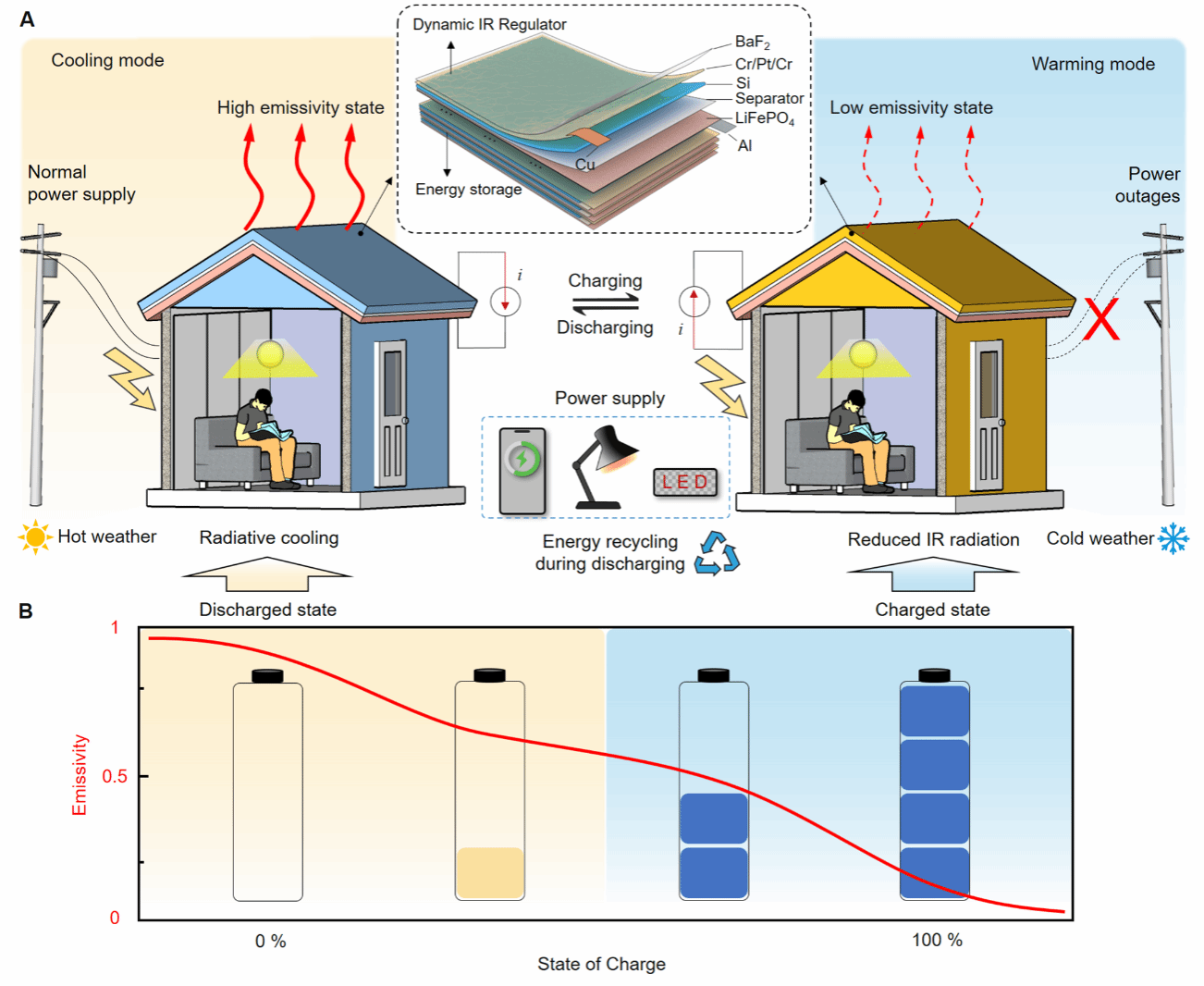
Figure 1: Conceptual schematic of SEP devices for dynamic energy-efficient buildings and their application in energy storage and recycling. (a) Schematic illustrating the operating principle of SEP devices integrated into building roofs or exterior walls, enabling on-demand thermal regulation and power supply. The top inset illustrates a multi-layered stacked cell structure, wherein the upper SEP device primarily functions for dynamic thermal regulation, while the lower SEP device serves as an energy storage unit to enhance overall energy storage capacity, enabling the device's integrated utilisation as part of the building envelope. Note that the SEP device exhibits low infrared emissivity during charging, supplying electrical power to appliances; upon switching to a high-emissivity state, energy recovery and reuse are achieved (bottom inset). (b) Schematic illustrating the relationship between infrared emissivity and the state of charge (SoC) within the SEP device.
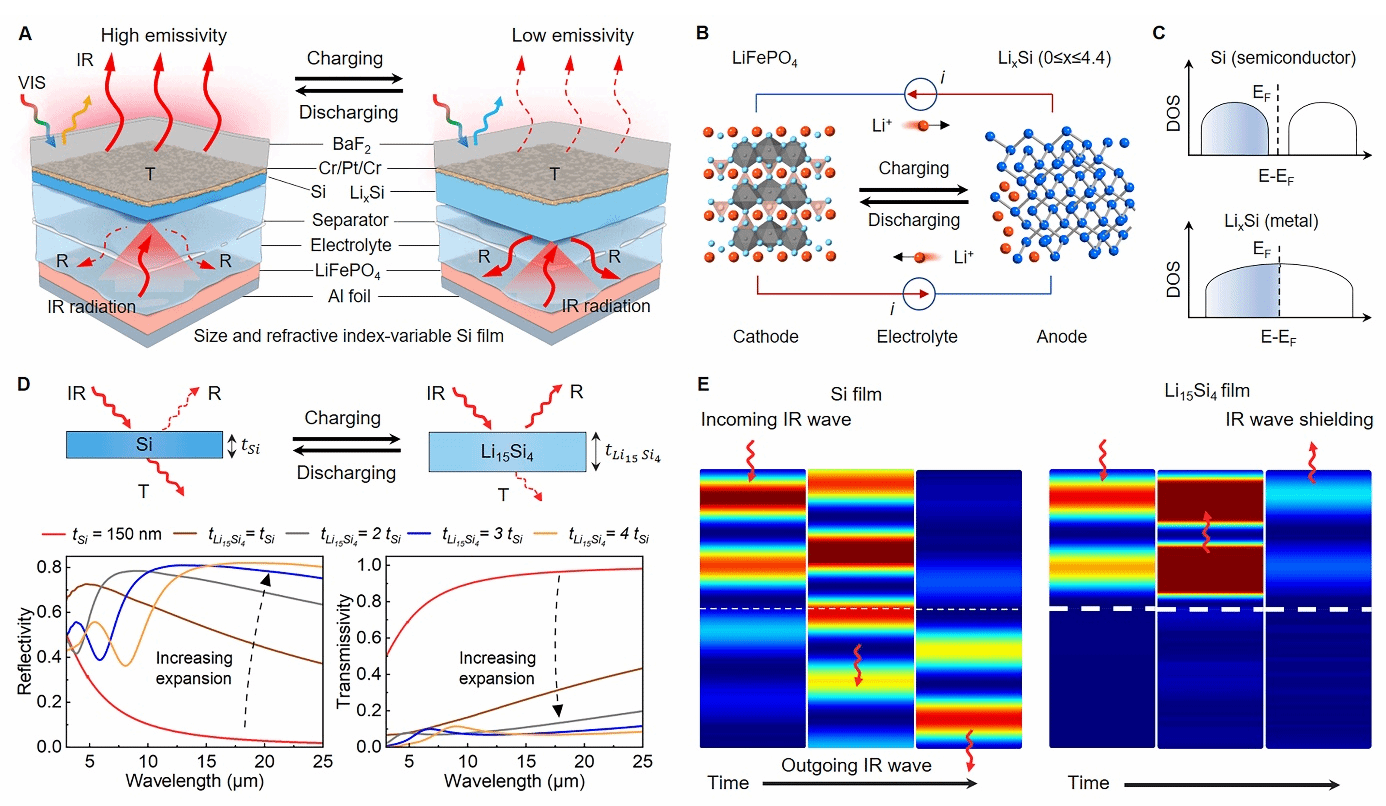
Figure 2: Design principle and theoretical analysis of the SEP device. (a) Schematic structure of the SEP device in the discharged state (left) and charged state (right). The device comprises a BaF₂ protective layer, a multispectral transparent Cr/Pt/Cr thin-film electrode, a Si thin film (negative electrode), an electrolyte-containing separator, and an aluminium foil coated with LiFePO₄ (positive electrode). (b) Schematic of lithium ion (Li⁺) intercalation and deintercalation within the Si film. During charging, Li⁺ intercalates into the Si film, increasing its thickness and altering its refractive index, thereby suppressing infrared emissivity; the reverse process occurs during discharging. (c) Schematic of the density of states (DOS) for Si and the Li-Si alloy. (d) Schematic of infrared light propagation through Si films and fully lithiated Li₁₅Si₄ films (top), alongside theoretical calculations of reflectance (R) and transmittance (T) for 150 nm thick Si films and Li₁₅Si₄ films of varying thicknesses (bottom). Li₁₅Si₄ film thicknesses are 150, 300, 450, and 600 nm, representing 1, 2, 3, and 4 times the volume expansion of the Si film after lithiation. (e) Characteristic plots of the dynamic electric field distribution (|E|²) for a 150 nm thick Si film (left) and a 350 nm thick Li₁₅Si₄ film (right) when irradiated with infrared light at a wavelength of 10 μm.
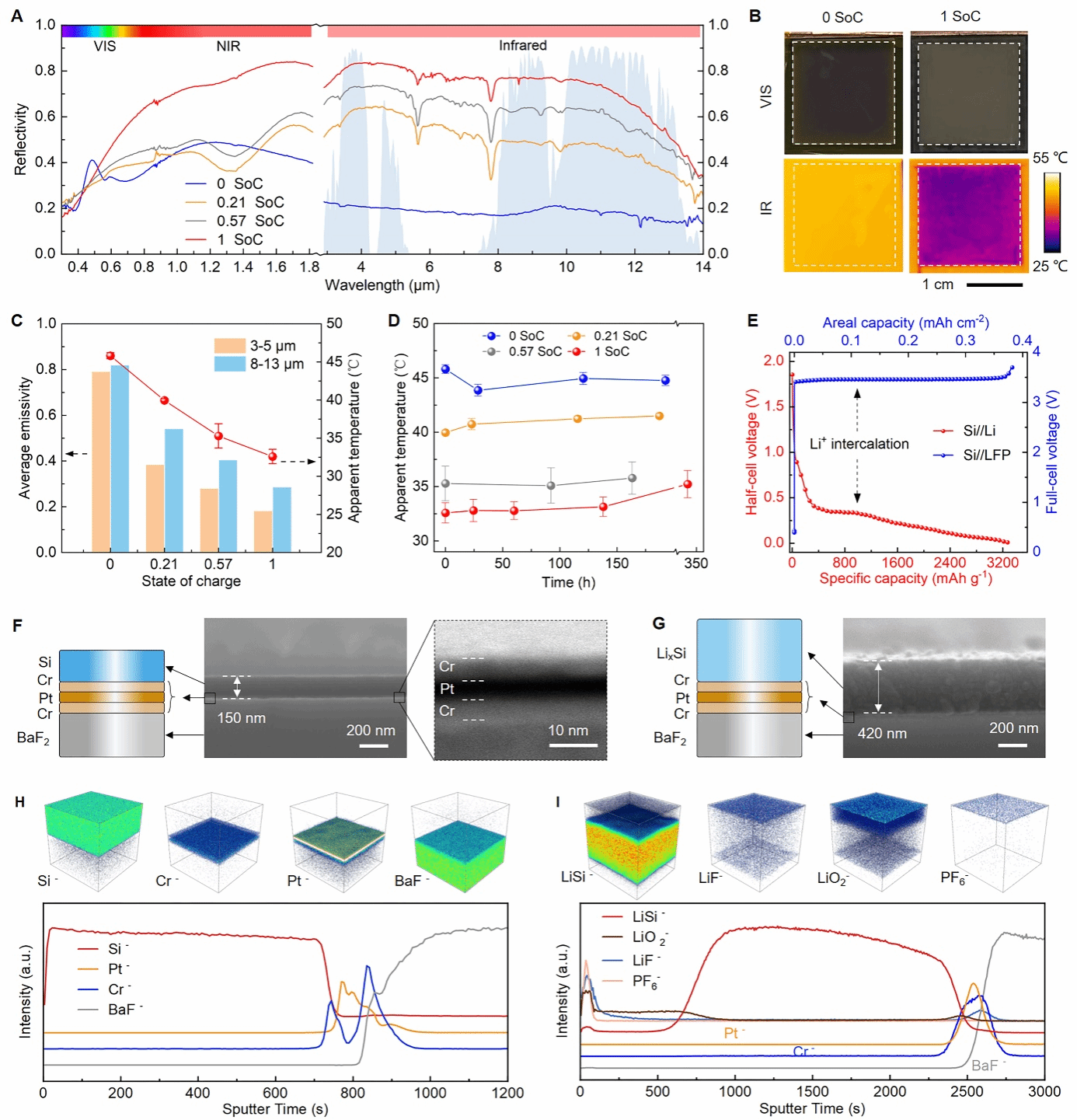
Figure 3: Visualisation of performance characteristics and structural deformation of SEP devices before and after lithiation. (a) Reflectance measurements of SEP devices across visible, near-infrared, and infrared bands at varying states of charge (SoC), showing an overall trend of increasing reflectance with rising SoC. The SEP device dimensions used in this experiment were 2.5 cm × 2.5 cm. (b) Visible light (VIS) and long-wave infrared (LWIR) images of the same SEP device at different SoCs, with the white dashed box delineating the device's effective area. (c) Relationship between the average infrared emissivity and apparent temperature of the SEP device in the LWIR band versus SoC. (d) Non-volatile test results of the SEP device under different lithiation states (SoC). (e) Typical voltage-capacity curves of the SEP device (Si//LFP full cell) and a half-cell based on SEP material (Si//Li), illustrating the Li⁺ insertion process. (f) Schematic cross-sectional structure (left), scanning electron microscopy (SEM) image (centre), and transmission electron microscopy (TEM) image (right) of the SEP material device in the discharged state (Si/Cr/Pt/Cr/BaF₂). (g) Cross-sectional SEM image of SEP material in the charged state (LixSi/Cr/Pt/Cr/BaF₂). (h, i) Time-of-flight secondary ion mass spectrometry (TOF-SIMS) depth profiling of SEP material during discharge (h) and charging (i), displaying distributions of multiple characteristic ion fragments. Above: Three-dimensional spatial reconstruction images of representative ions. Li₂O and LiF generate LiO₂⁻ and LiF₂⁻ ion signals respectively, while LixPFy and residual lithium salts produce PF₆⁻ ion signals.

Figure 4: Applications of SEP devices in building energy conservation and power supply. (a) Global distribution map of SEP device energy-saving potential, based on standard buildings and global climate data. (b) Annual energy savings, energy efficiency improvement rates, and carbon reduction effects calculated using a typical office building model and meteorological data from different cities (Data Source 1#). (c) Comparison of annual energy savings and efficiency improvement rates for SEP devices under different installation methods. (d) Schematic of an energy supply system constructed with SEP devices, where a DC/DC converter regulates the output voltage to meet electrical equipment requirements. An ammeter-voltmeter records output current and voltage to calculate the electrical energy converted by the SEP device. (e) Photograph of experimentally fabricated large-area arrayed SEP devices, each measuring 5 cm × 5 cm. (f-h) Demonstration of SEP devices powering a display screen (f), small fan (g), and white 3 V LED (h, inset). The display and LED are powered by a 3 cm × 3 cm SEP device, while the fan is powered by a 5 cm × 5 cm device. Current and voltage variations during LED operation are simultaneously recorded. (i) Calculated single-household energy storage capacity and power supply duration for SEP devices with varying layer counts under a conversion efficiency (RE) of 71.6%. The number of device layers directly correlates with the extended duration of power supply per household. (j) Performance comparison between SEP devices and other electrochromic devices.
Research Centers
Research Capacity
m² Total Area
Building Complexes

沪交ICP备201251287 Copyright © 2025 ZIAS
 Address:No.1308 Keyuan Road, Pudong District, Shanghai
 Phone:86-21-54740000
 E-mail:zias@sjtu.edu.cn
