搜索







 Time:Jun 11, 2025
Recently, Associate Professor Ni Jun's team from the Centre for Innovation in Synthetic Science at the School of Life Sciences and Technology/Zhangjiang Advanced Research Institute, Shanghai Jiao Tong University, published their latest research findings in Nature Synthesis online, titled ‘Chemoenzymatic platform with coordinated cofactor self-circulation for lignin valorisation’. This study successfully overcomes two longstanding technical bottlenecks in lignin conversion and the synthesis of additive-type natural products such as flavourings: high cofactor dependency costs and low catalytic efficiency. It provides a novel solution for the sustainable, high-value utilisation of lignin resources. Associate Professor Ni Jun from the School of Life Sciences and Technology, Shanghai Jiao Tong University; the State Key Laboratory of Microbial Metabolism; and the Centre for Innovation in Synthetic Science at Zhangjiang Advanced Research Institute served as corresponding author. Liu Liangxu, a doctoral candidate at Shanghai Jiao Tong University, is the first author, with Shanghai Jiao Tong University listed as the primary institution.
The value-added conversion of lignin represents a critical step towards achieving economically viable and environmentally friendly lignocellulosic biorefining. However, lignin's complex structure and recalcitrant nature constrain its high-value utilisation, primarily due to reliance on costly cofactors and the low efficiency of existing conversion systems. Addressing this challenge, Ni Jun's research group seamlessly integrated cell-free protein synthesis (CFPS) technology with a cofactor recycling system. They proposed and constructed an in vitro multi-enzyme coordinated expression and cofactor recycling system (iMECS), achieving highly efficient biocatalytic conversion of lignin derivatives.
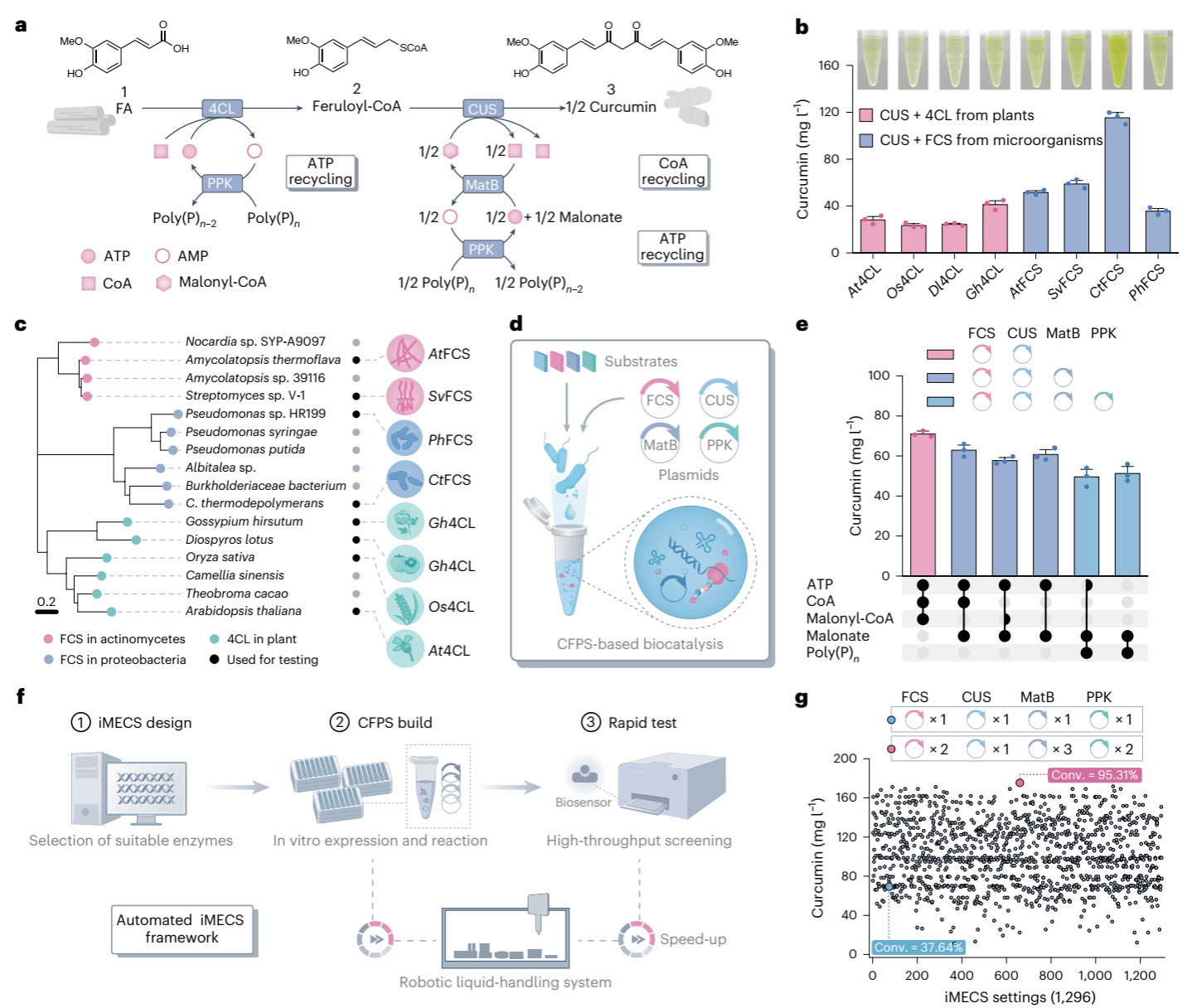
The research team systematically evaluated the versatility and adaptability of the iMECS platform across diverse natural product synthesis pathways, successfully achieving the efficient synthesis of multiple additive-type natural products including curcumin, vanillin, and raspberry ketone. Without the addition of exogenous cofactors, the conversion rates for each target product exceeded 90%. Moreover, the platform exhibits high modularity, enabling flexible adaptation to synthesise diverse phenylpropanoid compounds through enzyme replacement and pathway expansion.
Furthermore, researchers developed a hybrid route combining chemical depolymerisation with iMECS. By integrating chemical depolymerisation of lignin, ferulic acid and p-coumaric acid were liberated from diverse agricultural wastes. The iMECS system then efficiently converted lignin-rich agricultural residues into high-value products, achieving an overall catalytic efficiency 48 times higher than existing systems. This research meticulously engineered functional modules for natural product synthesis pathways and ingeniously introduced cofactor self-recycling modules. Through precision regulation at the DNA level, it successfully achieved dynamic equilibrium among precursor substances, energy supply, and reducing power. Moreover, this cell-free system-based prototype design not only demonstrates formidable synthetic potential but also provides a robust theoretical and technical foundation for developing and applying high-efficiency cell factories for flavouring additives, paving new avenues for future innovation and advancement in related fields.
This work received support from the National Natural Science Foundation of China and the National Key R&D Programme of China.
Original link: https://doi.org/10.1038/s44160-025-00819-2
Research Centers
Research Capacity
m² Total Area
Building Complexes

沪交ICP备201251287 Copyright © 2025 ZIAS
 Address:No.1308 Keyuan Road, Pudong District, Shanghai
 Phone:86-21-54740000
 E-mail:zias@sjtu.edu.cn
