搜索





 Time:Jul 03, 2025
On 3 July 2025, the research group of Professor Zhou Han from the School of Materials Science and Engineering at Shanghai Jiao Tong University and the Zhangjiang Advanced Research Institute, in collaboration with the team of Academician Zhang Di from the State Key Laboratory of Metal Matrix Composites at Shanghai Jiao Tong University, Academician Qiu Chengwei from the National University of Singapore, and Professor Zheng Yuebing from the University of Texas at Austin, achieved a major original breakthrough in the field of artificial intelligence (AI)-driven thermal radiation metamaterials. The research findings, titled ‘Ultrabroadband and band-selective thermal meta-emitters by machine learning’, were published online in the academic journal Nature, heralding a new chapter in the inverse design of optical and thermal metamaterials.
This study pioneers the establishment of the first AI-driven autonomous development platform for thermal radiation metamaterials. It combines three-dimensional structural primitives with spatial arrangements across multiple material systems, resolving major challenges in multi-material, multi-configuration, and multi-parameter design and optimisation. The research creates an automated matching database linking ‘materials-configurations-spectral properties,’ providing novel inverse design paradigms and methodologies for photonics and metamaterial design.
Thermal radiation, as a vital energy transfer mechanism in nature, holds significant application value in zero-energy radiation cooling and aerospace thermal management through precise regulation. However, traditional design approaches for thermal metamaterials predominantly rely on empirical trial-and-error with single structures, resulting in prolonged material development cycles. This hinders the coordinated optimisation of complex three-dimensional configurations and multi-material systems, thereby constraining spectral response control capabilities and engineering applications. In recent years, the application of AI technology in materials research has accelerated the photonic design of materials. However, existing AI model algorithms struggle to achieve parametric modelling of complex three-dimensional structures, and cannot perform automatic optimisation matching and global optimisation across multiple configurations and materials.
Addressing these challenges, the research team drew inspiration from biological topological configurations and their derived extraordinary optical and thermal properties (such as radiative cooling and ultra-broadband absorption). They innovatively proposed an AI-driven inverse design model for thermal radiation metamaterials. This model integrates 32 three-dimensional structural primitives—including spheres, cylinders, ridge-like structures, and triangular prisms—along with diverse spatial arrangements and 30 candidate materials. Based on the team's pioneering ‘tri-plane modelling method’, this model parameterises complex three-dimensional structures into 11 key variables, achieving the first-ever high-dimensional design space modelling and global optimisation for thermal radiation metamaterials. The AI model has generated over 1,500 high-performance thermal radiation metamaterial candidate schemes, delivering unprecedented breakthroughs in design efficiency, dimensionality, and design space. Its efficiency and performance significantly surpass traditional machine learning algorithms (Figure).
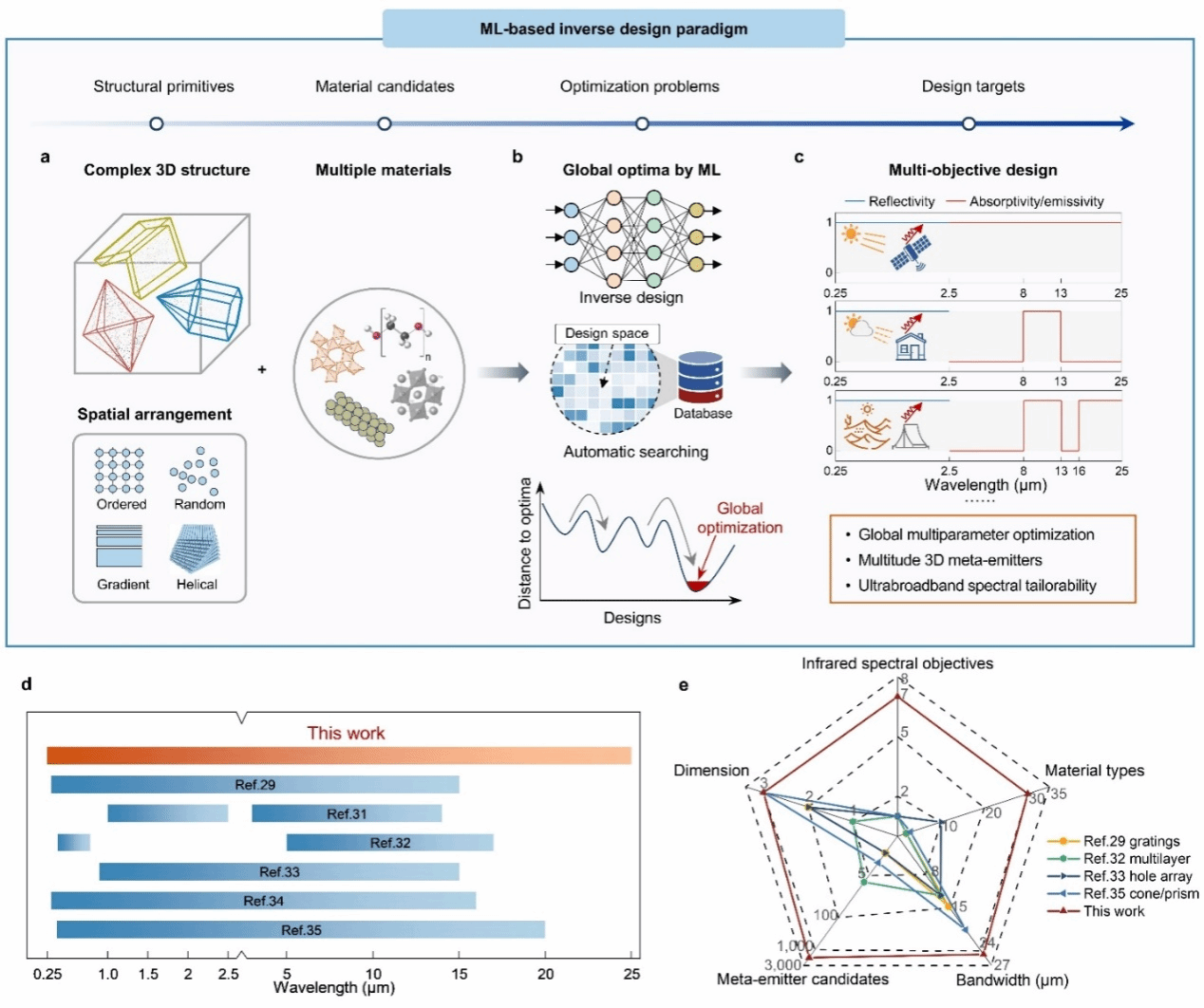
Fig. AI-based Inverse Design Paradigm and Characteristics for Thermal Radiation Metamaterials
The team utilised this model to design and validate seven application-specific thermal radiation metamaterials, including broadband thermal radiation metamaterials, single-band selective and dual-band selective thermal radiation metamaterials, among others. These encompass diverse material forms such as flexible films, coatings, and patches. Field tests across multiple outdoor scenarios demonstrated that these materials consistently achieve cooling effects below ambient temperature. Materials with distinct spectral characteristics proved suitable for different outdoor environments. For instance, under clear skies, the broadband metamaterial achieved a temperature reduction of 5.9°C at midday, with a cooling power of approximately 120 W/m². Under cloudy conditions, single-band selective metamaterials demonstrated more pronounced cooling performance, achieving a 4.6°C reduction below ambient temperature. In addressing urban heat island effects, single-band selective metamaterials shielded thermal radiation from buildings, with surface temperatures 2.5°C and 5.3°C lower than those of broadband metamaterials and commercially white-painted surfaces respectively. Further testing revealed that model roofs coated with dual-band selective metamaterials exhibited surface temperatures 5.6°C lower than commercially white-painted surfaces and 21°C lower than grey-painted surfaces, demonstrating substantial potential for mitigating urban heat islands.
This model not only provides efficient design capabilities for research but also enables the selection of metamaterial systems with engineering feasibility and economic viability from thousands of generated designs. For instance, the designed dual-band selective emitter can be fabricated via a simple solution process at room temperature and applied as a coating onto diverse substrates including brick walls, metals, plastics, and glass, demonstrating robust industrial transfer potential. Further energy consumption simulations indicate that large-scale application of dual-band selective thermal emitters on building roofs in mid-to-low latitude regions could achieve energy savings of 75 MJ/m², with a comprehensive cost lower than current commercial products.
By leveraging an AI-driven paradigm for materials research, the team comprehensively enhanced the design dimensions, speed, and performance of materials. This enabled the on-demand automated inverse design of ultra-wideband and multi-band selective thermal radiation metamaterials. The created thermal radiation metamaterials hold significant application prospects in numerous fields, including ground radiation cooling, building energy conservation and cooling, and aerospace thermal management.
Xiao Chengyu, a doctoral researcher from the School of Materials Science and Engineering at Shanghai Jiao Tong University and the Zhangjiang Advanced Research Institute, is the first author of the paper. Corresponding authors include Professor Zhou Han from the School of Materials Science and Engineering at Shanghai Jiao Tong University/Zhangjiang Advanced Research Institute, Academician Zhang Di from the State Key Laboratory of Metal Matrix Composites, Academician Qiu Chengwei from the National University of Singapore, and Professor Zheng Yuebing from the University of Texas at Austin. Shanghai Jiao Tong University is listed as the first completing institution. This work received funding from the National Natural Science Foundation of China and the Shanghai Municipal Science and Technology Commission.
Original link: https://www.nature.com/articles/s41586-025-09102-y
Research Centers
Research Capacity
m² Total Area
Building Complexes

沪交ICP备201251287 Copyright © 2025 ZIAS
 Address:No.1308 Keyuan Road, Pudong District, Shanghai
 Phone:86-21-54740000
 E-mail:zias@sjtu.edu.cn
