搜索






 Time:Jul 28, 2025
Recently, the internationally renowned journal Advanced Materials (2025, e07192) published a paper entitled ‘Rigid-Flexible Strategy Realises Robust Ultralong Phosphorescence for Multifunctional Display Unit and Photoreceptor Synapse’ by Professor Hu Zhiyu's team from the Centre for Future Materials Innovation at the Zhangjiang Advanced Research Institute, Shanghai Jiao Tong University. By concurrently introducing a hydrophilic rigid network and a hydrophobic elastic network, the team achieved an amorphous phosphorescent polymer with long-lasting narrow-band light activation. This polymer exhibits a phosphorescence lifetime of 4.71 seconds, a phosphorescence efficiency of 42.1%, and a full width at half maximum (FWHM) of merely 24 nanometres. This work provides valuable insights for designing high-quality phosphorescent materials, with potential applications in display technology and biomimetic light-sensing synapses.
Organic room-temperature phosphorescent materials have garnered significant attention across optoelectronic displays, bioimaging, and information encryption due to their captivating optical properties. Presently, most persistent luminescent materials remain confined to transition metal and rare-earth ions, whilst organic molecules are considered suboptimal for sustained luminescence owing to their low spin-orbit coupling efficiency and substantial molecular motion. In recent years, diverse strategies have been proposed to achieve stable three-state exciton emission, including small-molecule crystallisation, heavy-atom approaches, metal frameworks, and polymerisation techniques to realise long-lifetime phosphorescence. Nevertheless, most phosphorescent materials remain unable to balance phosphorescence lifetime and efficiency, exhibiting broad half-widths that preclude sustained narrow-band phosphorescence emission.
The research team anchored the planar chromophore 9H-dibenz[a,c]carbazole (BCz) within a polymer matrix of polyvinyl butyral (PVB). Through the dual action of PVB's rigid and flexible segments, non-radiative transitions of BCz were effectively suppressed, yielding an amorphous, transparent, and highly efficient phosphorescent polymer. Furthermore, the incorporation of elastic segments enhances the polymer's water resistance, enabling stable phosphorescent emission in aqueous media. This polymer material facilitates straightforward full-colour expansion and holds broad application prospects in 3D printing, colour displays, and simulated light-sensitive synapses.
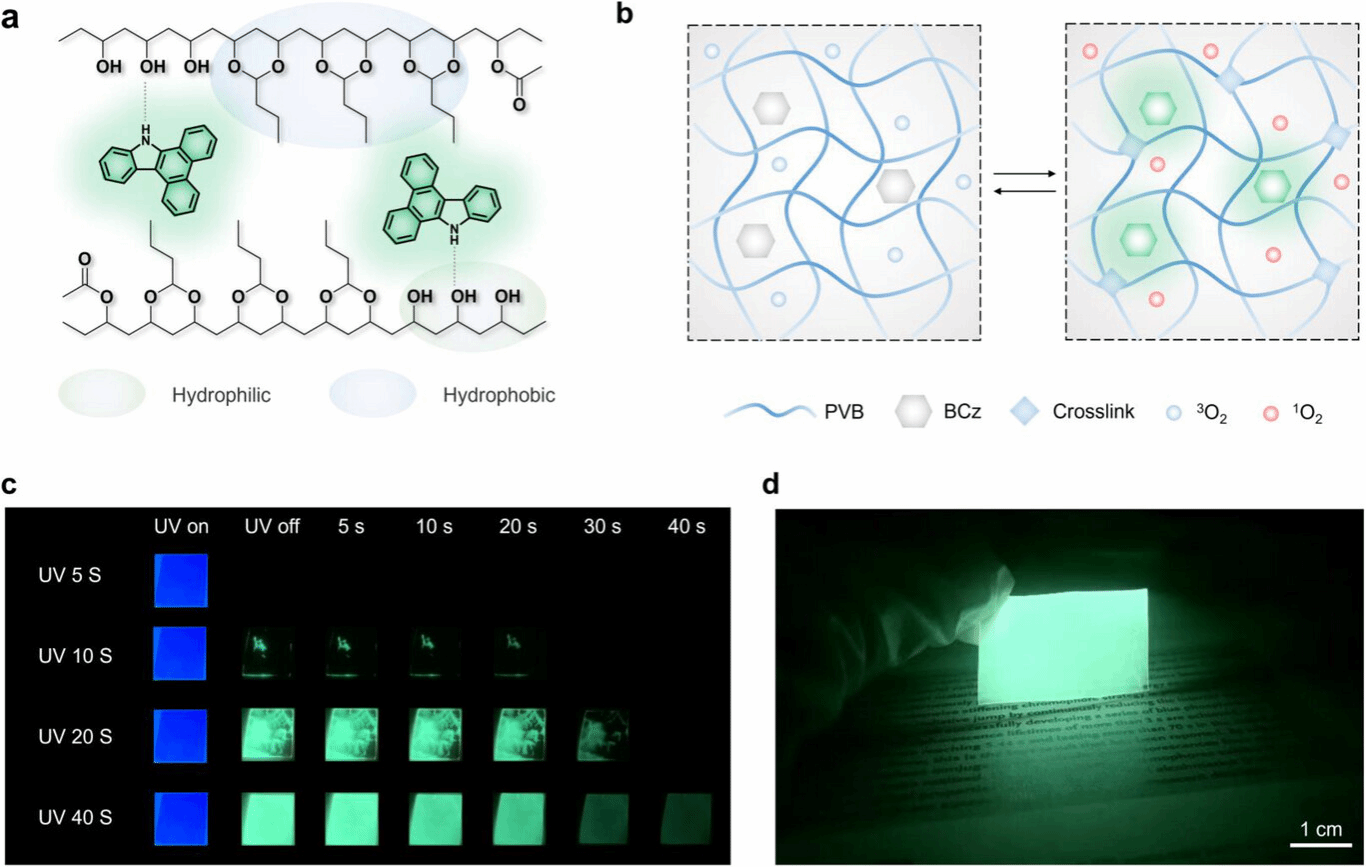
Figure 1 a) Confinement of the chromophore BCz through the simultaneous introduction of rigid hydrophilic and elastic hydrophobic segments. b) Mechanism of photoactivation in BCz/PVB films: Under UV irradiation, triplet oxygen within the film is activated to singlet oxygen, whilst partial cross-linking occurs internally, thereby exciting the triplet state of BCz. Notably, this photoactivation is reversible. c) Fluorescence and phosphorescence images of the BCz/PVB film over time following UV activation for 5, 10, 20, and 40 seconds (excitation wavelength = 365 nm). d) The phosphorescence of the BCz/PVB film is exceptionally bright, readily illuminating a dark environment.

Figure 2 a) Normalised photoluminescence spectra and URTP spectra of BCz/PVB films after 30 s UV activation (excitation wavelength = 365 nm, URTP spectrum delay time = 10 ms). b) Phosphorescence lifetime (collected via kinetic decay method, excitation wavelength = 365 nm) and phosphorescence quantum yield of BCz/PVB films after 30 s UV activation. c) Phosphorescence lifetime and phosphorescence quantum yield of BCz/PVB films compared to reported phosphorescent amorphous polymers, where hollow points denote narrow-band phosphorescent amorphous polymers. d) Phosphorescence spectra of BCz/PVB films at different UV activation durations (excitation wavelength = 365 nm, delay time = 10 ms). e) Activation-erasure cycle of phosphorescence intensity in BCz/PVB films. f) Electron paramagnetic resonance (EPR) signals of BCz/PVB before and after UV activation.

Figure 3 a) Transmittance measurements of BCz/PVB films. b) Normalised PL and phosphorescence spectra of BCz/PVA films (excitation wavelength = 365 nm). c) Phosphorescence lifetime of BCz/PVA films (collected via kinetic decay method, excitation wavelength = 365 nm). d) PVB exhibits water resistance due to hydrophobic blocking, whereas water molecules readily disrupt hydrogen bonds within the PVA system. e) Phosphorescence intensity of BCz/PVB and BCz/PVA over time. f) Changes in phosphorescence intensity of BCz/PVA and BCz/PVB before and after water stimulation. g) Photoluminescence images of BCz/PVB and BCz/PVA films over time in an aqueous environment.

Figure 4 a) Simplified Jablonski diagram for the FRET process. b) CIE colour coordinates corresponding to the phosphorescence spectra of BCz/PVB films with different dye doping ratios. c) Phosphorescence spectra of BCz/PVB films with varying Fluc doping ratios. d) Phosphorescence spectra of BCz/PVB films with varying RhB doping ratios. e) Phosphorescence lifetimes of BCz/PVB films with varying Fluc doping ratios. f) Phosphorescence lifetimes of BCz/PVB films with varying RhB doping ratios. g) Photographs of full-colour phosphorescent films (from left to right: 3Cz/PVB, BCz/PVB, BCz/PVB-F, DBCz/PVB, and BCz/PVB-R).

Figure 5 a) Phosphorescence photograph of a pattern screen-printed using BCz/PVB ink. b) Phosphorescence photograph of a 3D-printed model. c) Colour phosphorescent film for colour displays. d) Proposed biomimetic photosensitive synapse concept. The response of the entire display dot array to ultraviolet irradiation may be regarded as analogous to the human eye's reaction to light stimulation, with each dot functioning as a photosensitive synapse. e) Upper panel: phosphorescence images of BCz/PVB dots after light stimulation at varying intensities, where dark spots within red dashed lines indicate weak or absent light stimulation; bright spots within white dashed lines represent strong light stimulation. Lower panel: phosphorescence images of BCz/PVA after light stimulation at varying intensities. f) Schematic of light stimulation at different intensities. Grey denotes weak light stimulation; green denotes strong light stimulation. The PVB film responds to both strong and weak stimuli, enabling the display of desired information. The PVA film exhibits no response to either stimulus intensity and cannot display effective information. g) Stability performance of PVA and PVB dots. When exposed to water stimulation, the PVA dot array suffers information loss (white dashed circles in the upper image), whereas the PVB dot array remains stable under water stimulation.
Zhi-Hao Guan, a joint doctoral candidate from the Centre for Future Materials Innovation and the School of Materials Science and Engineering at Shanghai Jiao Tong University's Zhangjiang Advanced Research Institute, is the sole first author. Professor Zhi-Yu Hu is the sole corresponding author. This work received support from the National Natural Science Foundation of China and other institutions.
Paper link: https://doi.org/10.1002/adma.202507192
Author:
Hu Zhiyu's Team
Photography:
Centre for Future Materials Creation
Research Centers
Research Capacity
m² Total Area
Building Complexes

沪交ICP备201251287 Copyright © 2025 ZIAS
 Address:No.1308 Keyuan Road, Pudong District, Shanghai
 Phone:86-21-54740000
 E-mail:zias@sjtu.edu.cn
