搜索







 Time:Oct 14, 2025
Recently, Associate Professor Lü Baiqing from the Centre for Ultrafast Science at the Li Zhengdao Institute/School of Physics and Astronomy/Zhangjiang Advanced Research Institute, Shanghai Jiao Tong University, alongside Professor Nuh Gedik from the Massachusetts Institute of Technology, Professor Wang Nanlin from Peking University, Assistant Professor Zong Alfred from Stanford University, Associate Researcher Wu Dong from the Beijing Institute of Quantum Information, Researcher Meng Sheng from the Institute of Physics, Chinese Academy of Sciences, Researcher Jacob P. C. Ruff from Cornell University, and Dr. Su Yifan from Columbia University have achieved significant progress in the layered semiconductor charge density wave material EuTe4. They extended moiré superstructure research to bulk materials featuring intrinsic non-commutative stacking (Figure 1), reporting a moiré superstructure with a giant thermal hysteresis effect in the quasi-two-dimensional charge density wave material EuTe₄. The findings were published in Nature Materials.
EuTe₄ has garnered increasing attention for its unique properties, including a giant thermal hysteresis effect and temperature-insensitive in-plane charge density wave vectors. These characteristics indicate complex interactions between stacked non-commutative monolayers and bilayer charge density waves. However, stacking disorder and other crystal defects have hindered direct experimental evidence in bulk materials. Through high-throughput, high-resolution X-ray diffraction measurements on mechanically exfoliated ultrathin EuTe₄ flakes, the research team successfully distinguished lattice modulations along the out-of-plane direction. This provides the first direct experimental evidence for the coexistence of monolayer and bilayer charge density waves with distinct modulation vectors (Figure 2): The modulation vector for the monolayer is q₁ = 0.644(5)b*, while that for the bilayer is q₂ = 0.678(5)b* + 0.5c*, where b* and c* denote the reciprocal lattice basis vectors.
Building upon this, the research team discovered:
1. The stacking of charge density waves with in-plane modulation vectors differing only minimally generates a non-commutative moiré superstructure with an in-space periodicity of approximately 13.6 nanometres. Concurrently, interactions between this moiré superstructure and the lattice further form a commutative moiré modulation.
2. Although the double-layer and single-layer charge density waves are each non-commutative, they are jointly locked onto a highly symmetric lattice via the relation q₁ + 2q₂ = 2b* + c*. This explains the anomalous behaviour where q₁ and q₂ remain temperature-independent.
3. Intriguingly, the direct competition between the strength of the co-locked monolayer/bilayer charge density waves and the commutative Moire reconstruction generates a Moire superstructure exhibiting substantial thermal hysteresis effects. This phenomenon constitutes the root cause of the observed giant thermal hysteresis in resistivity.
This work not only opens a new chapter in exploring Moire physics in layered materials with stacked non-commutative orders but also provides crucial insights into the unique properties of EuTe4.
The paper's co-first authors are Lü Baiqing, Yifan Su and Alfred Zong, with Professor Nuh Gedik as corresponding author. Shanghai Jiao Tong University is the primary institution contributing to the paper. This work received funding from the National Natural Science Foundation of China, the Ministry of Science and Technology, and the Shanghai Municipal Science and Technology Commission.
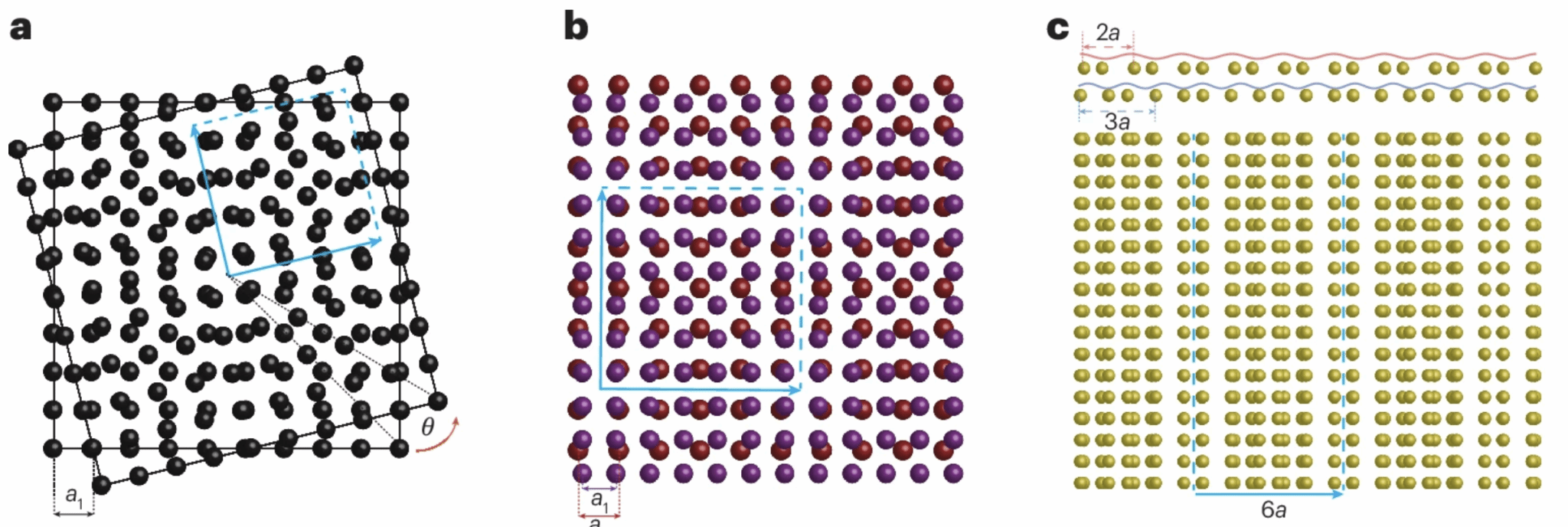
Figure 1: Several representative formation mechanisms of Moire superlattices
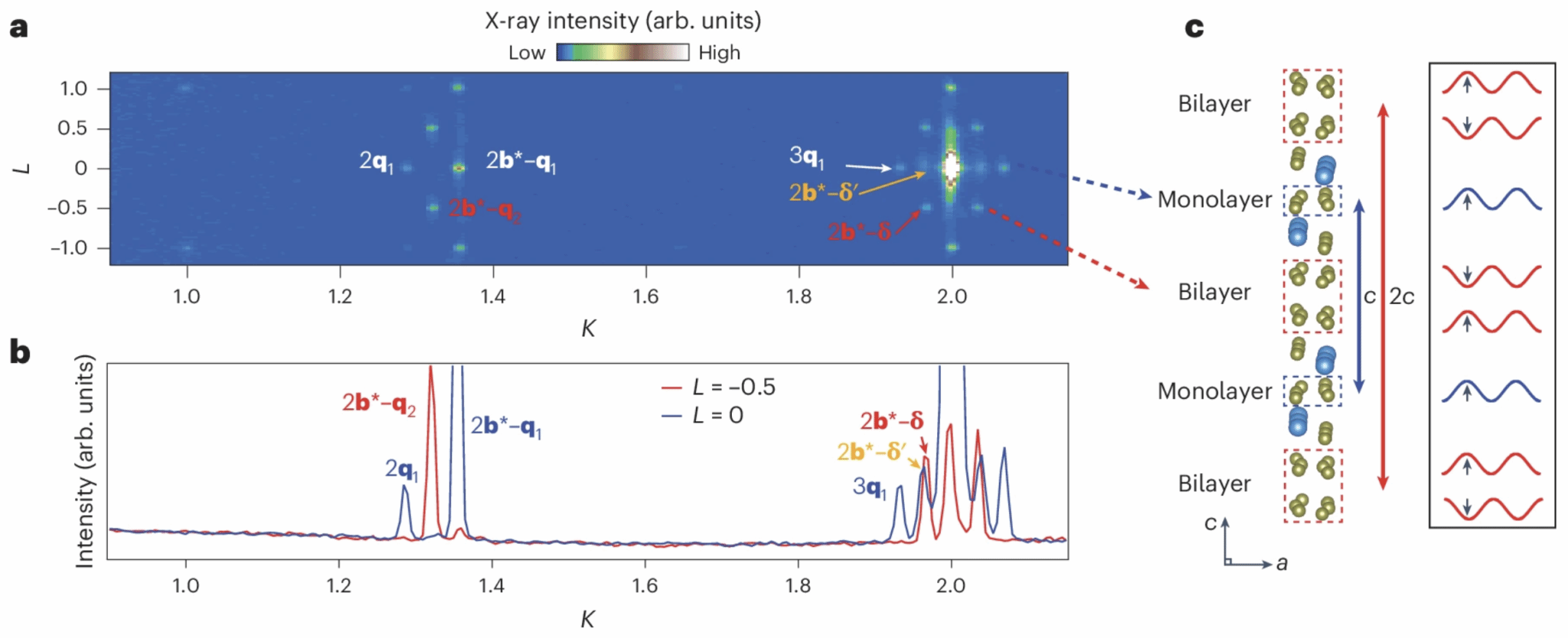
Figure 2 X-ray diffraction pattern of EuTe₄ and schematic diagram of charge density wave modulation structure.
Paper link:
https://www.nature.com/articles/s41563-025-02360-1
Research Centers
Research Capacity
m² Total Area
Building Complexes

沪交ICP备201251287 Copyright © 2025 ZIAS
 Address:No.1308 Keyuan Road, Pudong District, Shanghai
 Phone:86-21-54740000
 E-mail:zias@sjtu.edu.cn
