搜索







 Time:Sep 16, 2025
Recently, a research team led by Professor Qian Dong from the School of Physics and Astronomy at Shanghai Jiao Tong University and the Centre for Ultrafast Science at the Zhangjiang Advanced Research Institute, in collaboration with researchers from Stanford University, Clemson University and other institutions, utilised a self-developed megavolt ultra-fast electron diffraction system supported by the National Natural Science Foundation of China's Major Scientific Instrument Development Programme. Combined with first-principles calculations, they quantitatively revealed the structural origin of light-induced bandgap suppression in the exciton insulator candidate material Ta₂NiSe₅. The findings, titled ‘Structural contribution to light-induced gap suppression in Ta₂NiSe₅’, were published in Physical Review Letters (Physical Review Letters 135, 096901, (2025)).

Figure 1: Crystal structure of Ta₂NiSe₅ and ultrafast electron diffraction experimental diagram
Ta₂NiSe₅ has long been regarded as a strong candidate material for exciton insulators. However, intense debate persists regarding whether its low-temperature energy gap originates from exciton condensation or is driven by structural phase transitions. Previous studies employing time-resolved angle-resolved photoemission spectroscopy (tr-ARPES) and ultrafast spectroscopy have elucidated the material's band structure and carrier dynamics. However, the absence of direct observation of atomic motion has hindered definitive identification of the mechanism underlying its photoconductive gap evolution.
In this study, the team employed a megavolt ultra-fast electron diffraction system with 50-femtosecond temporal resolution and broad momentum detection range to simultaneously track the dynamic evolution of nearly 100 Bragg diffraction peaks. Unlike previous studies relying on only a few diffraction peaks to infer structural dynamics, this work established approximately one hundred independent constraint equations through global fitting of multiple diffraction peaks. This enabled precise quantitative reconstruction of atomic motion following photoexcitation. This methodology overcomes a long-standing challenge: simultaneously requiring ultra-high temporal resolution to capture femtosecond-scale structural evolution and sufficient diffraction information to ensure solution uniqueness and reliability. Consequently, this study quantitatively reconstructs the post-photoexcitation atomic trajectories at femtosecond (1 fs = 10⁻¹⁵ s) temporal and sub-picometre (1 pm = 10⁻¹² m) spatial scales.
The findings reveal that the displacement of Ta atoms along the crystal's a-axis reaches a maximum of approximately 2.6 picometres after about 200 femtoseconds, approaching the position of the high-temperature orthorhombic phase in equilibrium. This significantly suppresses the distortion of the monoclinic structure. Concurrently, experiments reveal that atomic displacement along the a-axis saturates with the 2THz phonon amplitude at high pump intensities, indicating coupling between this phonon and excitons, with the saturation behaviour consistent with an exciton depletion mechanism. Conversely, atomic displacement along the c-axis and the 3THz phonon amplitude increase linearly with light intensity, suggesting weaker exciton correlation.
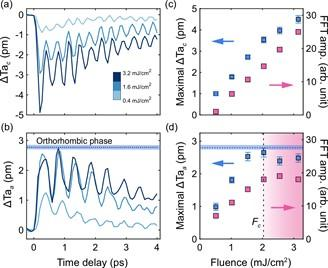
Figure 2: Evolution of atomic displacement in Ta₂NiSe₅ following photoexcitation as a function of time and incident light energy density
Further integration with first-principles calculations reveals that structural evolution alone suffices to induce bandgap closure, even without considering exciton correlations; this aligns with the band evolution observed via tr-ARPES. It is noteworthy that the saturation behaviour of atomic displacement revealed by ultrafast electron diffraction correlates with the bandgap evolution observed in previous photoelectron spectroscopy and the saturation trend in phonon oscillation amplitudes observed in ultrafast spectroscopy. This further indicates that the photoinduced structural phase transition plays a dominant role in the bandgap evolution of Ta₂NiSe₅.
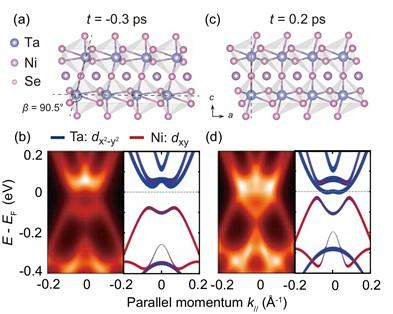
Figure 3: Electronic band structure of Ta₂NiSe₅ before and after photoexcitation, as calculated by first-principles methods.
This study demonstrates the unique advantages of combining terahertz ultrafast electron diffraction with global multi-peak fitting methods in the investigation of strongly correlated systems. It not only provides crucial evidence for understanding the physical mechanisms of exciton insulators but also offers a powerful tool for exploring the coupling relationships between atomic structures and electronic degrees of freedom in complex materials. Furthermore, this work demonstrates that, compared to equilibrium studies, non-equilibrium investigations can reveal the multi-degree-of-freedom evolution and coupling processes in materials under transient excitation, providing unique insights unattainable through equilibrium approaches.
This work received funding from the National Natural Science Foundation of China and the National Key Research and Development Programme. Chen Zijing, PhD candidate at Shanghai Jiao Tong University; Xu Chenhang, postdoctoral researcher at Stanford University; and Xie Chendi, PhD candidate at Clemson University, are the co-first authors of the paper. Professor Xiang Dao, Professor Qian Dong from Shanghai Jiao Tong University, and Professor Alfred Zong from Stanford University are the co-corresponding authors.
Paper link: https://journals.aps.org/prl/abstract/10.1103/1kzk-sz7g
Research Centers
Research Capacity
m² Total Area
Building Complexes

沪交ICP备201251287 Copyright © 2025 ZIAS
 Address:No.1308 Keyuan Road, Pudong District, Shanghai
 Phone:86-21-54740000
 E-mail:zias@sjtu.edu.cn
